Sunday, 14 October 2018

Beekeeping in the Long Hot Summer of 2018

Well, it was a bit boring really.


The limitations of wifi temperature gauges became apparent.
If you read my last blog you will know how pleased I was that I could see activity in the hives without opening them up during the Beast from the East and Beast from the East Two storms.  When the weather was eventually clement enough for the first inspection, the limitations of wifi temperature gauges became apparent.  While the G Bees were building up as expected, the newest colony had no queen.  I had observed that there was a difference between the two colonies from the behaviour of the bees on the landing board.    Clearly something must have happened to her in the Spring and that's one thing you can't put down to bad beekeeping because I hadn't opened the hive.   Normally, the bees would just create a new queen but there was no guarantee there had been any eggs for them to create a queen from, no signs of queen cells and worse, evidence of laying workers.

When worker bees lay, the brood is not in a neat, circular pattern but more like ribbons.  This was a completely new experience for me and I consulted all the usual sources, eventually deciding to follow the Ted Hooper advice and dismantle the colony leaving the bees to find new homes (most likely with the G Bees).   When I started to carry out the process, P spotted a Queen.  (He's very good at that; much better than I am still.)   Where I think I may have made a mistake is that I carried on with the dismantling plan and perhaps I should have taken time to reconsider.  Anyway, I started the season with one colony in the home apiary.  The colony in the out apiary appeared to have absconded.

I took off honey at the end of May just as the oil seed rape flowers were fading......but it seems the bees weren't working oil seed rape!   There were beans flowering, there's a hint of hawthorn in the flavour and it has set like rock.  As usual, the bees won't say where they had been.

Dad inspected the hive in the out apiary, confirming there were no residents and got it ready to take a nucleus or split if one became available.  

It was so hot that experienced beekeepers were wondering whether the wax inside the hive would melt.   
From the middle of May until now, in October, we've had an exceptionally warm season.   For most of the summer, it was also windy.  The warm wind stopped the heat feeling oppressive but the bees don't like to be disturbed when it's windy and I left them to it simply giving them more space regularly.   Eventually the hive was taller than I am.   In early August it was so hot that experienced beekeepers were wondering whether the wax inside the hive would melt.   The thought had crossed my mind but I reasoned that bees are kept in much hotter places than here so I tried not to worry.   

A swarm took up residence in the out apiary and built up nicely over the season.

I had to wait for a not quite so windy day and for a cricket game to be cancelled so P could help my lift the supers off the G Bee hive because they were so heavy.   

At the local honey show, Lot 9 from last year, now set and nicely marbled, came second in the set honey class.  The Long Hot Summer of 2018 in a jar, Lot 11, didn't win a prize although lots of people kindly pointed out it was indistinguishable from Sally's clear honey that won second prize in that class.  My honey fruit cake came third :)


The 29th September was one of the loveliest days this year.  The temperature was 23C, there was absolutely no wind, it was sunny but not scorching and that's the day I sorted the G Bees out for the Winter.  As usual, they have a new floor, new brood box, a full super of honey and the frames in the 14 x 12 brood chamber are wall to wall honey.   I turned over the entrance blocks to the Winter setting.   There are nine narrow holes which are too narrow for a mouse to pass through.  This stops any mice from setting up home in the warm hive on a cold night.  The G Bees were not happy about that.  They were clearly still foraging in large numbers and they couldn't get in an out fast enough.  They've got used to the entrance now and I've set up the wifi temperature gauge again.

It is challenging to get the timing right for setting the hive up for Winter.  It seems too early judging by the plants that are flowering but any day now we could see temperatures returning to their normal range for this time of year.

Monday, 26 March 2018

Bee Weather 2018

How my friends in Finland laughed when I told them we were experiencing an extreme weather event with temperatures of -4.5 Celsius and wind chill making it feel like -9.


The Beast from the East was sweeping across Finland too and they sent me their weather forecast for the week:  temperatures weren’t forecast to exceed -19 Celsius.

My Christmas Present Thermpro TP60 (see the Winter Beekeeping 2017-2018 blog ) has turned out to be vastly more useful than I expected.  I had thought it would be interesting to monitor temperatures in my hives:  I didn’t appreciate how truly useful it would be to be able to observe activity in the hives without opening them up.

The unusual-for-us-cold weather, (let’s not call it extreme), has had beekeepers all over the country worrying whether their colonies have survived.  Some have resorted to peeking inside.  That’s tempting but a sure way to chill the bees.  Apparently, in freezing temperatures, some bees can enter a state of torpor and bees in this state are sometimes presumed dead even when they aren't.

With the aid of the Thermpro and without leaving my kitchen, I have been able to see that there are bees alive in the hives.

To be honest, when I first set up the devices I thought they were just measuring the ambient temperature.   I considered that the small difference between observed temperatures in the hives and the ambient temperature was probably accounted for by the devices being sheltered from wind chill and the worst of the weather by being inside the hive on the crown board just under the roof.   

After a few weeks, the variance from ambient temperature grew noticeably.  By the time the Beast from the East struck, I was confident that the in hive devices were measuring bee colony activity, albeit I can’t tell whether temperature changes reflect an increase in the number of bees or how close the colony is to the sensor.

The following graph shows the ambient temperature compared with the temperature in each hive.   The trend lines clearly indicate increasing activity in the beehives.


This second graph shows how the variance from the ambient temperature is growing.


It's still too cold too open up the hives for the first inspection this year but both colonies are flying and bringing back pollen when the sun shines or the wind drops.    They still have fondant as an emergency food supply but trees are starting to flower now so it looks as though both colonies in the garden apiary have survived the Beast from the East 1 and 2 and Winter 2017/2018.   Phew!

Tuesday, 30 January 2018

Winter Beekeeping 2017 - 2018

The 2017 Honey Lots

This weekend we had the local beekeepers' branch Annual General Meeting so it's time to report on that and to note what is flowering in the garden now for comparison with previous years.

Regular readers will know that the main reason for belonging to the local beekeepers' branch is the outstanding quality of refreshments at any gathering of members.  This year's AGM and dinner were no different, literally.  The menu was exactly the same as last year but nobody complained.  It's an inspired idea to hold the dinner immediately after the AGM to maximise the number of members who attend the AGM.   The branch is doing well and no new catering equipment had to be purchased.  

Prizes were awarded for winning entries in the local honey show back in August.  No cup for me this year.  My entries were limited to a jar of clear honey and a jar of set honey because we had to deliver our entries a week in advance due to travel plans.  Lot number 6, the first honey extracted in 2017 won 2nd prize in the set honey class.   Lot number 7 was unplaced in the clear honey class.   In terms of taste this year, Lot number 8 is my favourite.   It's just beginning to crystallise; the texture is creamy and the flavour is full and rounded but we didn't extract lots 8 and 9 until after the show.  It's the first year we've had such dark honey.  We don't know where the bees were foraging.  They won't say, however, we have sent a sample off to the National Botanic Gardens in Wales and they have promised us an insight in due course based on their DNA Barcoding.


I am the only person who had a Thermpro TP60 Digital Wireless remote Thermo-hugrometer for Christmas. 

As always, the dinner is an opportunity to pick the brains of experienced beekeepers and to compare notes.   Honey yields were average;  experience with wasps varied.   I am the only person who had a Thermpro TP60 Digital Wireless remote Thermo-hygrometer for Christmas.  With this I can monitor the temperature and humidity of the two hives in the garden apiary from inside the house.  I have placed the sensors on the crown board above the brood chamber so they are inside the outer casing of the hive.  

Initially, I thought the sensors were just reading the ambient temperature.   The sensors show a temperature approximately 2 deg Celsius above the ambient temperature and one hive is consistently about 0.2 deg celsius warmer than the other.  However, in the last week we've had some warmer temperatures and then there is  sometimes a greater differential between the hive sensor readings and the ambient temperature.  The temperatures in the hive also seem to stay warmer for a while after the ambient temperature starts to drop down in the evening.  The reading will be affected by heat generated by bee activity but also by the location of the cluster within the hive but nobody can tell me what temperature I should expect to see - as for humidity.....!


G Bees Varroa tray after 1 week January 2017
Originally, I hoped to be able to tell whether the colonies are alive by using the sensors.  I know they are alive anyway because I can see chewed wax cappings on the varroa trays where they are using their stores.   Now I think I may be able to observe when the Queens start laying more and activity levels  increase towards the end of next month and in to March without opening the hives.

This picture shows the G Bees Varroa tray.  The pale debris is wax cappings from honey stores;  the darker debris is wax  from the brood chamber.  A week earlier, the pale wax debris was at the right front of the hive.  Now it's very central so they are moving around.  The bees do have fondant too just in case they run our of their own stores.


Flowers on bloom

This Winter we've had a few days of snow and some milder weather.  It's been quite wet and very windy.  The following flowers were on bloom this weekend:  aconites (well there were buds), the first snowdrops, winter flowering honeysuckle, cyclamen coum, winter box (sarcocca) and the daphne odora is just coming out.


Sunday, 10 September 2017

Results of the Nasty Queen Replacement Plan


The weather is suddenly autumnal and next door have ploughed the field.    I managed to carry out my last big inspection of the bees to get them ready form the Winter season.   The big question was, how would the new colony, comprising the home bred queen and her progeny combined with the Nasty Queen's colony, behave?

The theory, as I understand it, is that a colony of bees shares the characteristics of their mum, the Queen, who may have mated with one or more drones.  Therefore, unless you can control which drones the Queen mates with, there is a risk that her progeny will inherit their dad's characteristics instead of their mum's.    By giving my nucleus eggs from the lovely G Bee Queen from which to develop a new queen, I was doing my best to produce a new Queen with lovely G Bee characteristics but I couldn't control who she would mate with.

Over the Summer, it became evident that the new Queen and the bees that hatched from her eggs are "normal" bees who concentrate on their bee business and take no notice of me unless I disturb them, which I try not to do.

When I united the Nasty Bee colony with the new Queen's colony after the demise of the Nasty Queen herself, I expected the united colony to have 40-50% of bees with Nasty bee characteristics until those Nasty bees gradually die off.  At this stage in the season, the colony does diminish in size as the Queen does not lay so many eggs and more bees die off than are hatching.

What I didn't expect was that just a couple of weeks after uniting the colonies, the new colony would be so well behaved.    Over the last 2 years I have got used to the Nasty Colony sending out alarm pheromones as soon as I lift the crown board and guard bees pinging my veil at eye level almost immediately after that.

This time, there was none of that.  No sticking of little bottoms in the air when I took off the crown board, no angry guards harassing me.    It's the result I planned for but I am still surprised that to find such benign behaviour so quickly.  


Both colonies now have clean varroa floors, a full-ish super of stores, a clean brood chamber and there is enough room between the crown board and the roof for me to feed them as required over coming weeks and in late Winter.


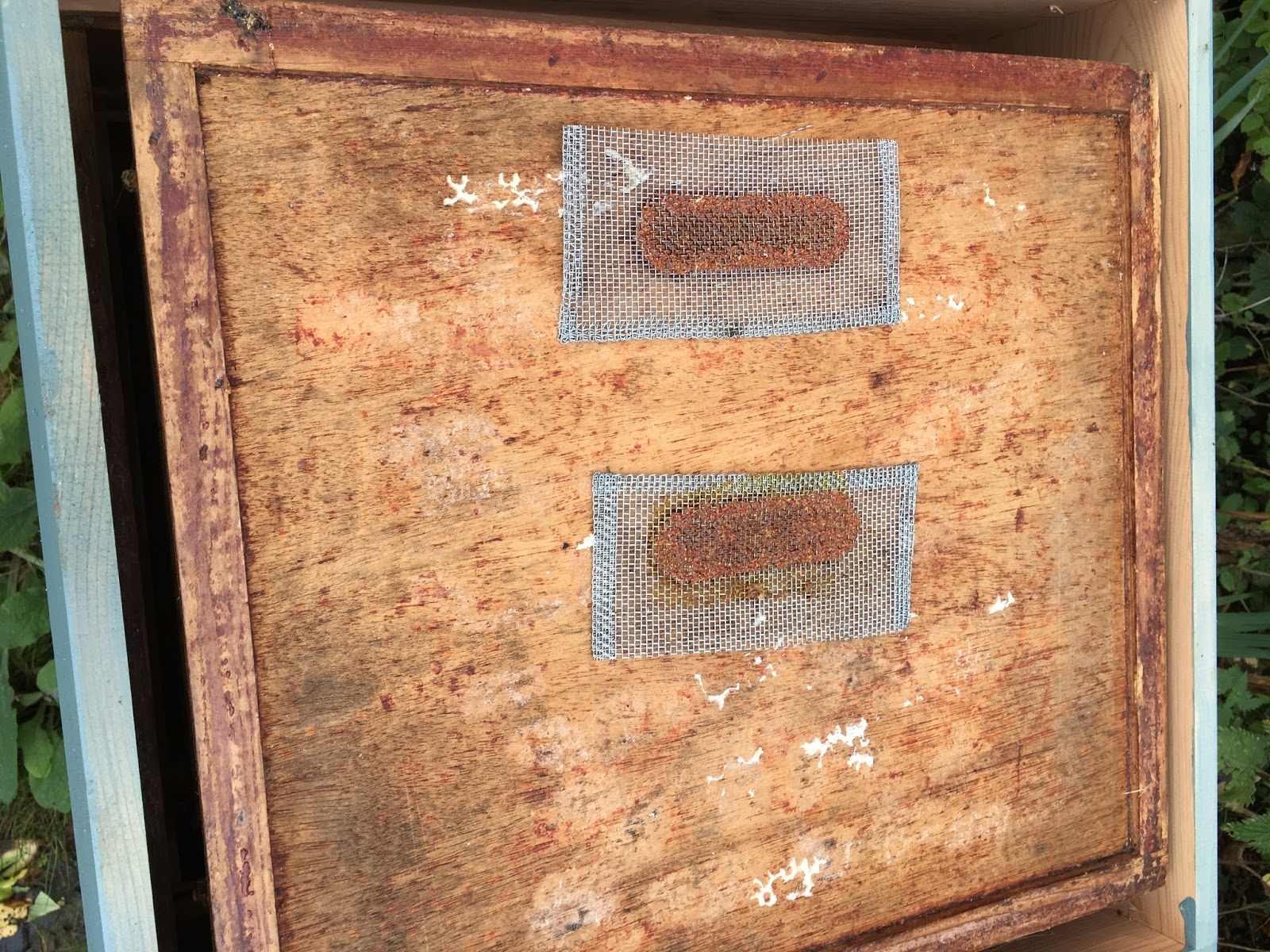
Their behaviour may now be similar but there is one respect in which the two colonies are completely different.  The crown board in the picture on the left came off the G Bees.  They don't like ventilation.   Crown boards often have a couple of holes in the top  which can be fitted with bee escapes (a kind of one way valve) when you want to move bees down from one part of the hive to another, e.g. in order to remove a super of honey.   


In the summer, I usually cover the holes with wire mesh so the bees have some ventilation.  The lid of the hive stops rain getting in and it also has ventilation holes but the G Bees have completely sealed the metal grills that cover the holes in the crown board with propolis.  They have also sealed the edges of the varroa floor with propolis.  


The new colony has glued the wire mesh to the crown board with propolis but left the centre clear.

Wednesday, 9 August 2017

Nasty Queen Replacement Plan Part 2

The time has come to implement part 2 of the nasty Queen Replacement Plan


As we approach the end of the season, the time has come to implement part 2 of the Nasty Queen replacement plan which involves finally finding and killing the Nasty Queen and then uniting the colony with the new colony headed by Queenie, the new Queen raised this year from a G Bee Queen egg.

Last week, I visited Bob at the bee shop to buy the Varroa treatment that I will need soon and, as usual, I got a lesson from him - this time on how to find and kill a problem queen.   

Bob recommended putting on every piece of protective clothing I have, dismantling the hive and taking the brood box well away from the apiary then inspecting each frame and shaking off surplus bees onto grass in order to find the queen.  This process should be repeated again and again until the queen was found, then she could be stamped on.   The hive could be reassembled on its usual stand in the apiary so that all the bees would return home.  Finally, the colony could be united with another colony in the usual way, or alternatively, a frame of new eggs from a from another colony could be inserted for the bees to raise a new queen.

My regular outfit for inspecting the Nast Queen colony is jeans and a long sleeved T Shirt, scarf round my neck, disposable nitrile gloves under washing up gloves under long beekeeping gloves, cricket hat, beekeeping suit and wellies.  It gets hot!

No sign of the queen
As I can't lift a full brood chamber easily, I used a nucleus box to move a few frames at a time as far away from the apiary as possible.  
I carefully inspected all the frames and couldn't find the Nasty Queen.   
I shook off surplus bees but there was no sign of the queen.  
I returned the frames to a new brood chamber and repeated the process until the old brood chamber was empty and the new brood chamber was back on the stand.  There was still no sign of the queen but there were a lot of bees on the grass at the bottom of the garden.   

The weather forecast was for showers so I put a cover board against the hedge so the bees still on the grass had somewhere to shelter in case they couldn't get back to the hive.

Next day, with better weather, I repeated the process.   I found an empty queen cell on one of the frames in the brood chamber.   (Could they really create a queen cell so quickly or did I miss it the day before? ) I still didn't find the queen.   

There was a group of bees that had spent the night by the hedge and their demeanour made me think it was likely that the queen was amongst them.   I consulted Dad and he suggested shaking the bees onto a sloping sheet, placing the skep on it and watching the bees march into the skep.  He said I would see the queen running over the other bees to get in the skep.  I've heard of this process for getting bees into a hive but I haven't observed myself.    

this was the point when I belatedly realised that I wasn't sure I could kill her even if I spotted her

It was fascinating to see the bees send out scouts in all directions to the edge of the sheet looking for somewhere suitable to congregate.  They returned to the main mass of bees and I saw wiggle dances.  After a few minutes, a few bees moved slowly into the skep, then others followed them and then there were two rivers of bees running purposefully and swiftly into the skep.    I couldn't see the queen but this was the point when I belatedly realised that I wasn't sure I could kill her even if I spotted her.    Perhaps that was why I hadn't found her since March.  Perhaps subconsciously I didn't want to find her because I couldn't actually kill her.     Absolutely convinced that I couldn't stamp on her, I picked up half a brick and carried on watching the bees.  I was feeling a total failure as a beekeeper because I couldn't even spot a queen bee on a white sheet.

When about three quarters of the bees had moved into the skep, suddenly I saw her.  She looked fatter than I remembered but there was no doubt it was the queen and not a drone.  She was running alone up the middle of the sheet between the two main rivers of running bees.   Without hesitation I put the brick on her and then stood on it, massively relieved that there were no other bee casualties.


The rest of the bees eventually made their way into the skep.  It may be my imagination but they were quivering and looked lost.    In the evening, I put their brood chamber with the bees that were still in it onto the new colony and shook the bees from the skep into the brood chamber.    The blog from 31 August 2015 explains the process for uniting two colonies of bees.   I'll leave them alone for a week and hope they are happier when they realise that they are in Queenie's colony.

The final act (I hope) of the Nasty colony was to sting P  when he arrived home from cricket.  He wasn't near the apiary but a bee got behind his glasses.  Bob says he doesn't mind follower bees but he doesn't like greeters.  P was met by a greeter.  
The Nasty Queen had to go.

Sunday, 28 May 2017

Implementing the Nasty Queen Replacement Plan


The first Problem
As a beginner beekeeper, my first problem is making a new Queen to replace the Nasty Queen.  

Any egg in a beehive can end up as a worker or a Drone or a Queen depending on the size of cell the egg is laid in and the food it is given.  Drones have noticeably larger cells that workers and Queen cells are so large they hang off the frame.  So, if a colony "loses" a Queen, the bees can construct an emergency Queen cell around an existing new egg to grow a replacement Queen.

There are lots of beekeeping techniques for making spare Queens and I must have read about most of them over the Winter.   I discussed options with other beekeepers and realised that everyone has their favourite foolproof method.    I decided that grafting queen cells and most other techniques sounded too complicated but I was more confident about setting up a nucleus hive with sealed brood, nurse bees, stores and a frame of eggs from my G Bee Queen and letting the bees do their own thing, so I decided to do that.  

Timing is everything.  I would need good weather for transferring a frame of G Bee Queen eggs safely into a nucleus.  Set up the nucleus too early and there aren't any Drones about for a newly hatched Queen to mate with.   The end of May is supposed to be the best time for Drones, so I had to count backwards from then to find the optimum time to start the process.   I took advantage of a beautiful day in April and put two frames of stores from the G Bees, two frames of sealed brood covered with bees from the Rubettes and one frame of eggs from the G Bees into a nucleus hive.  Any foragers that end up in the nucleus return to the main hive next time they fly out leaving the nurse bees to look after the sealed brood until it hatches.   By then the nurse bees and newly hatched workers all think the nucleus is their home so when they become foragers they return there.

A week later, quite a lot of the sealed brood in the nucleus had hatched and they had used one whole frame of stores.   I gave them another frame of stores to keep them going until they had enough foragers to bring their in their own stores.   I didn't inspect the frame that had been the G Bee egg frame for fear of it getting chilled but after another week, I found an empty Queen cell and when I closed up the nucleus, there were bees fanning on the landing board - normally a sign that there's a queen inside.  According to my beekeeper's rule (a sort of beekeeping slide rule that helps you work out how a colony is developing), it was entirely possible that a Queen had hatched in the last day or two so I might have an unmated Queen in there.

The Second Problem
Problem number two is finding and killing the Nasty Queen.  I didn't see the Nasty Queen during the whole of 2016.  This is partly because I didn't hang around looking at the Rubettes last season.   My objective in an inspection is to check for signs of the Queen (eggs, larvae and sealed brood), to check the colony is developing as expected and has space; to check they have adequate stores and to check for disease.   It isn't necessary to see the Queen if you can see signs of her. 

So at the very first inspection in March this year, I was astonished to see the Queen!!!!!!   The Nasty Queen is slim and black with a reddish brown tinge to her tail.   When I spotted her, I contemplated doing the deed but that would mean inspecting the Rubettes without fail each week to to make sure the colony weren't making a Queen from a Nasty Queen egg.  The weather is too unpredictable in March to be sure of being able to inspect the bees every week.    However, the main reason I didn't catch the Nasty Queen and commit reginicide was that I suddenly realised I didn't have enough hands to hold the frame and my hive tool and do something else at the same time.   

The next week feeling confident that I would shortly have a new Queen in the nucleus, I started to focus on finding the Nasty Queen.   I had just started the inspection when I realised, to my horror, that the zips on my veil weren't done up properly.  For a fleeting moment, as I calmly retreated away from the hive, I thought I might have got away with such a stupid error without the bees noticing but, that was when I heard the buzzing.  I had two stings, one on the back of the head and one on my forehead.   Luckily, P was on hand to scrape out the stings and find the oral antihistamine.  He also helped me finish the inspection but I spent the next 2 days looking like Melania Trump.    There are no photographs but having had this premonition, I will not be rushing to try the fashionable fillers and botox beauty treatment!   The Nasty Queen is still very much alive.

I now have two colonies of badly behaved bees!
Here's the thing.   The Rubettes are still the Rubettes.  The Nasty Queen is as productive as ever and it's a huge colony but the nucleus is also currently populated by bees that came from the Rubettes' hive.   They share the same characteristics as the Rubettes - pinging the veil and following me after an inspection so I now have 2 colonies of badly behaved bees!   

There is a small ray of hope.   At the last inspection of the nucleus, I saw lots of polished cells waiting for eggs to be laid in them and I think I saw the little elongated dots that are eggs in the bottom of some of them.   

Sunday, 21 May 2017

Bad Beehaviour

What to do about a badly behaved colony


Over the course of last year, it became increasingly apparent I had one badly behaved colony of bees, one colony of angelic bees and a "normal" colony in the out apiary.   So what's the difference?

My G Bee colony, descendants of the rescue G Bees (see blog for July 2014) are every bit as well-behaved as the original G Bees bred by Mr Griffiths.   When I open them to do an inspection, they go about their business as if I am not there.   Visitors used to watch inspections from only a few feet away (albeit, the other side of the apiary hedge) and I regularly took off gloves to take photographs with my phone during an inspection.     The Sue Bees in the out apiary aren't quite so tranquil but they don't make much fuss during an inspection and nephew H helps Dad look after them.  The Rubettes distinguish themselves by their aggressive behaviour.   As soon as I lift the crown board I see them sticking their bottoms in the air to waft alarm pheromones to the rest of the colony.  Shortly after that the guard bees start pinging my veil.  They fly into the veil at about eye level and keep up this behaviour throughout the inspection.  The Rubettes have a habit of sitting on me and they regularly follow me back to the shed or even the house after an inspection.  This accounts for the lack of photographs last season - I wouldn't dare remove gloves in the apiary - and it's the reason we've made visitors stay well away from the apiary during inspections.

The photograph above was taken after my first inspection of the Rubettes back in 2015.  At the time this sitting on my back and head seemed almost affectionate but when they sit on your arms....and you bend at the elbow....they sting.   I've also been stung through the seam on my gloves where the leather joins the gauntlet.  

I reverted to using leather gloves last season for inspecting the Rubettes simply because they are thicker but I have gradually developed full battle dress for inspecting them.  This comprises my bee suit, wellington boots, two long sleeved T Shirts, a scarf around my neck, a cricket hat under the hood, nitrile gloves under washing up gloves under rubber bee keeping gloves with long gauntlets.

So, what to do?

I spent the latter part of last season and the Winter talking to other bee keepers and reading books eventually coming up with a plan that I thought I could implement to replace the Rubettes' Queen, aka the Nasty Queen. As all the bees in a colony are descendants of the Queen, they carry her genes.  Replace the Queen with a well-behaved Queen and after about 6 weeks, you should have a colony of well-behaved bees.  But will the theory work in practice?


Saturday, 21 January 2017

Winter Beekeeping 2016

The Beekeepers' AGM and Weather Conditions Compared with Last Year


It's the weekend of the local beekeepers' AGM and annual dinner again (menu: Sliced gammon served with baked potatoes, coleslaw, mixed salad, two chutneys and assorted mustards; bread and butter pudding, or fruit salad, or chocolate flan, or chocolate roulade, or any combination; cheese and biscuits; coffee and mints).   The Chairman summarised the year for the organisation noting the purchase this time of a  second observation hive and, jointly with the county beekeeping association, a gazebo.  For once, it seems no new catering equipment was required.

Conversation over dinner included the usual comparison of fortune over the year.  We were lucky, it seems.  I was aware that a few miles to the North, beekeepers were feeding their bees during the same week that our GBees filled and capped a super with honey but I also learnt that a couple of miles South, bees were also being fed at that time.  At one of the apiaries nearest to us and closer to the centre of the village, they also had a huge honey yield so there must be something in the village that filled the gap for the bees between oil seed rape and autumn hedgerows.   We think it may have been lime trees.  They can, apparently produce large quantities of nectar but the temperature has to be just right at the right time for them to be valuable to bees.


It seems that wasps weren't such a problem for anyone this past year.   
Our bees in the home apiary survived the usual wasp attacks because we have learnt to put them on solid floors, or varroa mesh floors with the inspection tray underneath, supplemented by strips of rubber (actually old yoga mat) cut to fill any gaps and prevent wasps getting into the hive from underneath.   After reading an article in beekeeping news we made porches out of corrugated plastic sheet (which you can clearly see on the G Bees' hive above) and we filled any little gaps in the hive casing with foam.   We have left the porches on for the Winter but will probably take them off early int the Spring.

Penny recommends Waspinators, a kind of bag that imitates a wasp nest and which is supposed to deter wasps because they think there is already a was colony in situ.  I've already ordered a couple of them to try in the Summer.

We are all on the lookout for the dreaded Asian hornet.  Asian hornet nests were found in Gloucestershire towards the end of the season which could mean that that Queens are already over wintering somewhere....

Weather
A year ago when I blogged about the AGM and dinner, I also commented on the mild Winter we were having and listed all the plants flowering in the garden in late January.  What a contrast this year!  

We have had unseasonably mild weather up to Christmas.   The National Beekeeping Unit sent out a message to beekeepers in the last few days of December recommending the we give our colonies fondant as a supplementary feed because they were receiving reports that some colonies had used their stores because they were still flying rather than huddling in a ball.  

On 8th January, when we put the fondant on our hives, both colonies were flying in large numbers.  However, since then we have had a cold snap.   The only plants flowering this week are Winter flowering honeysuckle and Sarcococca (Winter Box).  The cold snap is taking its toll on other animals and plants too and we have lost our lovely Golden Hornet Crab Apple.    The bark has been stripped all round the trunk.  The culprits are rabbits because the damage is low down.    Muntjac deer chew bark from about 1 ft up to 2 ft and roe deer strip bark 3 - 4 ft up the trunk or from low branches.   Fortunately, all the trees in the orchard are protected by anti-rabbit devices (wire round their trunks).

Wednesday, 28 December 2016

Cooking with Honey


Kim and Tim visited the Hive at Kew Gardens this year #KewHive and, luckily for me, the bookshop was well stocked with beekeeping and honey related books.  My Christmas stocking included "Spoonfuls of Honey" by Hattie Ellis, "A complete guide to honey's flavours & culinary uses, with over 80 recipes."

It's an enchanting book, which I have already read from cover to cover.  A high proportion of the recipes are appealing (and it's not often I say that about a cookery book).  Yesterday, I was inspired to try "Roman Honey-Baked Ham".    Triumphant from the success of helping Tim on Christmas Eve with his honey and mustard glazed ham (Tiptree honey and mustard sauce mixed with demerara sugar), I happened to buy a ham yesterday to cook for this festive season.

I had to adapt the recipe slightly as I didn't have any dried figs; or breadcrumbs; or Dijon mustard.   

The photograph above is the succulent result of boiling the ham in water and apple juice with bay leaves, more-or-less as the recipe suggests.   The closest I could get to dijon mustard was a jar of mustard seeds.   I crushed them in a pestle and mortar and mixed them with honey (Lot number 3).   After cutting off the rind and scoring the fat,  I coated the ham with the honey and mustard mixture and studded the ham with cloves, just because it looks good.

It tastes every bit as good as it looks!   Happy New Year!

Friday, 11 November 2016

Hive Products

No! Not More Honey.


This afternoon I made pure beeswax creamed polish for use on leather or furniture.  The kitchen smells warm like my grandparents' drawing room, the room only used at Christmas and when they had important guests as opposed to the sitting room that they used every day and which didn't have any distinctive fragrance.   It's only now that I realise their best room smelled of beeswax and turpentine furniture polish!

I tried to get Great Grandfather's recipe for Bionic Polish.  I recall Mum making it and I know it was a very soft polish made with beeswax and turpentine but I don't know the proportions or whether there were any additional ingredients.  She used to put it into bottles rather than jars.   Great Grandfather's (only) other recipe is for "Embrocation" a magic lotion used to treat both people and horses for sprains and strains.    Mum made both and famously rubbed Dad's back with Bionic Polish by mistake when the labels fell off all the bottles in a damp cupboard.   The Bionic Polish recipe appears lost for the time being so I resorted to Mrs Beeton's recipe:

Shred 8.5 oz beeswax into a large jar.
Stand in boiling water until melted
Add 1.5 pints of turpentine slowly.
Stir rapidly to mix well.
Pour into wide-mouthed jars or tins to set.

I had exactly 8.5 oz of beeswax from the cappings removed in the last honey extraction.   In the absence of a suitable jar, I used an old coffee pot which has lost its lid.  Coffee pots don't seem to be useful anymore so what a great way to use it.


Shredding the wax with a box grater took a long time but it was a satisfying task and Friday afternoon radio kept me entertained.  I carefully poured in the pure gum turpentine off the heat and stirred  rapidly, then the jug came in to its own, making it really easy to pour the liquid polish into the jars and the electronic scales made it relatively easy to get the weight right in each jar.  

I visited Bob at the Bee Shop last week and bought the jars and labels.  He only had labels saying "at least 90g", which is technically correct as the jars hold 250g.   For some reason, I like the warning labels more than the polish labels.   Perhaps it's the bold black cross on a bright orange background.

I wonder whether I will write another blog to report how the polish works?  To do so, I'd have to do some polishing.  Hmmm.   Don't hold your breath!

Friday, 9 September 2016

Honey Shows

Read on to find out why I have posted a picture of a handsome silver cup!


After the great experience of the County Honey show last year, when I found out that the local beekeepers were going to have a gazebo at the local country show, I had to take part.

The number of classes was minimised but all of us were encouraged to enter as many classes as possible.

1. Clear Honey
2. Creamed Honey
3. Set Honey
4. Honey Fruit Cake
5. A pair of candles

Luckily, the bees produced clear honey as well as set honey this year but we don't process our honey to produce a creamy set, so that limited me to two honey classes.   Notwithstanding my poor attempt to win acclaim at the County Honey Show with my honey sponge last year, I decided to attempt the Honey Fruit Cake.    I have been developing my efforts to melt down wax but I haven't progressed to candle making yet; maybe I'll try that next year.   

Knowing some of my fellow beekeepers, I was in no doubt that I would have to put effort in to have any chance of a prize.  Sally sent me guidance on how to prepare honey for showing from an old beekeeping magazine- 3 pages of closely typed instructions!    Given that the honey was already in jars, all I could do was select nice examples and polish the outsides of the jars, then pack it so there were no finger prints to be seen.

As usual, I practised making the cake and as last year, this involved buying 2 new cake tins because I didn't have any the right size and the recipe said, make two cakes, enter the best one in the show and eat the other.   My first attempt was pretty good and the cakes were quickly eaten.   The second attempt, which included the cake I took to work for my colleagues to judge, produced crumbly cakes with a bit of a depression in the centre.  As you can see, my final cake also sank a little in the centre.

Anyway, you can see from the photo below that the Honey section of the Horticultural marquee looked splendid.


The gazebo was nearby and included an observation hive, a model bee hive, lots of books and photographs and a table for children to have a go at making candles from coloured wax foundation.
P and I had guests for the weekend and they enjoyed their afternoon at the show, especially the dog show, while I was volunteering in the gazebo and P played cricket several miles away (!)
As soon as I arrived, Sally asked if I could come back the following day to collect my trophy.  It transpired that both jars of honey had been awarded 2nd place in their respective classes and two 2nds trump a 1st, so I had won the trophy for the beginner with the most points at the show.

It was only later that I discovered that the clear honey (Lot No 5 if you read the previous blog) was 2nd in the beginner's class and the set honey (Lot No 3) was 2nd in the grown up beekeepers' class!
    
I am very proud of my bees!


If you are wondering why there's no photograph of me being awarded the trophy at the awards ceremony, it's because on the second day of the show, P and I, along with Kim and Tim and about 30 friends were on our annual 20 mile bike ride.  We never know the route until the day itself but we were riding through the village where the show was taking place so Kim, Tim, P and I diverted off the ride to try to pick up the trophy.   This was not allowed!  This meant I had to cycle home as fast as possible in order to jump in the car and drive back in time for the awards ceremony.   This was not without some risk as I had a blow out on the back tyre earlier in the day.   Fortunately, my cup was the penultimate one to be awarded.  I did have time to brush my hair but I was still wearing my cycling gear and I had been wearing a cycling helmet all day.  I haven't attempted to get a copy of the official photograph!


Monday, 22 August 2016

Found in Dad's Shed


Dad has given me this delightful cross stitch that he found when he was cleaning out his shed.  

Kittie was a well known beekeeper in the village and she gave Dad some of her equipment when she down-sized from her house with a very large garden on the outskirts of the village to a bungalow in the village centre about 30 years ago.    

We guess that Sheila was the vicar's wife.

The verse is the first stanza from a poem by Isaac Watts (1674 - 1748).

How doth the little busy bee
Improve each shining hour,
And gather all the day
From every opening flower!

How skilfully she builds her cell!
How neat she spreads the wax!
And labors hard to store it well
With the sweet food she makes.

In works of labor or of skill,
I would be busy too;
For Satan finds some mischief still
For idle hands to do.

In books, or work, or healthful play,
Let my first years be passed,
That I may give for every day
Some good account at last.

What makes this particularly touching for us is that both Kittie and Sheila were guests at our wedding 24 years ago.   Kitty has since passed away and Sheila and her husband moved away when he retired.

I have arranged a suitable frame and will be hanging this in the barn where we do the honey extraction.

Sunday, 14 August 2016

2016 Lot Number Notes

So much honey we have to make notes about each batch


This year the bees have been extraordinarily productive.   Each colony has its own honey for the Winter and we will supplement that with Winter feed to get a better idea of the quantity and quality of stores that they have going in to the Winter.  We have removed the surplus honey over the season in 5 separate batches which are identified with separate lot numbers on the honey jar  labels.

This is raw honey, not pasteurised, heat treated, blended  or mechanically stirred.   Each lot is manually extracted by centrifugal force, filtered to remove bits of wax and put straight into jars.  

All honey will eventually crystallise and set.  The time this takes depends on how long it is stored and at what temperature.   White frosting on the surface occurs naturally on crystallisation as air escapes from the honey and the honey may shrink a little from the shoulders of the jar.   Ideally, honey should be stored in airtight containers, ideally below 10℃.   Set honey can be made runny by gently warming it.

Lot Number 1

This honey was extracted from Colony 1, the Rubettes on 14th May 2016.   Made predominantly from oil seed rape, this honey had to be extracted before it set solid in the frames.   Oil seed rape honey is notorious for setting so hard that the bees struggle to use it themselves.   Originally pale and runny, it took on a stiff consistency within a week and set solid within two weeks.  You can feel the large crystals on the tongue.   Commercial honey is heat treated or mechanically stirred to produce uniform small crystals so you don’t experience different crystal sizes which result from the flowers the bees visited.  

Lot Number 2

Extracted from the Rubettes  on 28th May 2016.   The oil seed rape flowers were fading to green so this was the last of the predominantly oil seed rape honey.   Noticeably darker in its runny state than Lot Number 1 and taking three weeks to set softly, this honey has a subtle note of hawthorn in its flavour.  The texture is also relatively coarse.

Lot Number 3

Extracted on 16th July 2016, 50% from the Rubettes and 50% from the G Bees, this honey is a rich amber colour.   Slightly opaque and initially a thick syrupy consistency it has since set and has a pleasant flavour which is slightly stronger than Lot Number 2, possibly still with a hint of hawthorn.   Alex thinks it has some Horse Chestnut in it - and given the huge tree by the apiary, he is almost certainly correct.

Lot Number 4

This Lot was extracted on 24th July 2016.  50% from the G Bees was pale, clear honey with a light floral taste entirely made in the week since Lot 3 was extracted.  The other 50% came from the Rubettes and having been made before 16th July it resembles Lot Number 3.   Some jars are thick honey, others are runnier, presumably depending on the relative amount of honey from each hive that has ended up in each jar.

Lot Number 5

Extracted on 7th August, this late summer honey has a delicate taste with the slightest hint of citrus.  It is a  translucent amber colour and the runniest honey this year.    

Monday, 25 July 2016

National Bee Unit Husbandry Questionnaire

Reflecting on the changes in the apiary in the last year


In the post this week I received a survey from the National Bee Unit who monitor husbandry practices, colony losses and bee health.   The questionnaire covered 2015 and last Winter and as I answered it I realised what a lot has changed in our apiary!

We had 2 colonies back in April 2015, both in the home apiary, then Dad collected the Sue Bees swarm which was set up in the out apiary.   These bees built up  nicely but they got a bad reputation.  Dad took 18lb of oil seed rape honey off them in May and since then they have been chasing anyone nearby.   They joined Dee in the cab of his digger; they stung dad through his veil and they also got between his glove and bee suit...ouch!   They also subsequently swarmed although no sign of preparation for swarming had been noticed.   Dad is happy with the remaining Sue Bees and rather hopes they are calmer and less swarmy.  So far, so good.

The G Bees were almost lost to wasps and they overwintered in a nucleus box

By the end of last Summer, the two colonies in the home apiary were being predated by wasps.   In August we packed the remaining bees up and transported them to the out apiary where they overwintered in a  nucleus box (i.e. a VERY small hive).   

In late Winter, we took them back to the home apiary and set them up alongside the Rubettes, a robust new colony we acquired late last Summer, thinking we had lost the G Bees.   Answering the NBU survey according to their guidelines, the G Bees colony did qualify as a "lost" colony.   However, the G Bees built up well in the Spring, quickly occupying a 14 x 12 brood chamber and by mid-May we were able to take 2 full supers of oil seed rape honey off of the Rubettes and one off the G Bees.   

By Mid July, the Rubettes had 3 supers and I knew the bottom 2 were full.  The G Bees, still dubbed "the small colony" had 2 supers.   

Last weekend, I opened up the G Bees and realised they needed a third super too.  They were cramming wax and honey in every nook and cranny.    As I didn't have any frames ready, I emptied a super and put it back on wet.  Then I did the same for the Rubettes.  I could tell the Rubettes had more space, i.e. 3 supers already, because their hive was neat and orderly with no odd wax comb sproutings.   Both colonies were producing beautiful even sealed frames (see the photograph at the top).

I am in total awe of the G Bees!

So, imagine my surprise this weekend when I checked on the G Bees.   This, my colony that was almost predated to extinction last year; the colony that over wintered in a nucleus because it was so small had filled and capped a super in a week!   Where are they getting the nectar? No idea.  Everyone tells me it's too late for the bees to be making so much honey but the G Bees have never listened to convention.

The Rubettes, my fabulously strong and slightly grumpy colony had pretty much filled their wet super too but they haven't sealed the frames yet.

Both colonies now have an empty super to fill plus 2 full supers.   I have run out of honey buckets and jars.  I am in total awe of the G Bees.   There is nowhere on the NBU questionnaire to explain how my lost colony is now the strongest one!

Sunday, 15 May 2016

First Honey Extraction 2016

 
This is oilseed rape, the main crop growing around us this year.  This rogue plant popped up conveniently by a blue hoarding so the acid yellow colour really shows up and you can see that this plant is a brassica.   It is farmed for the oil its seeds produce.   Originally used primarily as a lubricant, modern oilseed rape oil has been developed to be safe and palatable for human consumption and the "cake" left over after processing is used as an animal feed.   It is also grown for biodiesel.  We love the nutty flavour and use it a lot.

For the beekeeper, the most noteworthy property of oilseed rape is how quickly honey made from it crystallises.  It has to be extracted even before the bees have sealed it over with wax otherwise it doesn't spin out.  I learnt from experience last year that oilseed rape honey left in the frames is even hard for bees to use once it's set.  Hence, this week we extracted the first honey of the season.                                                                               At the out apiary, the Sue Bees are just a few feet from a large field of oilseed rape.   On Monday Dad extracted 18lb of honey, a record for us from a single super (the box of frames where the bees only store honey as opposed to the larger brood chamber box where they have the nest and honey and pollen stores).

At the weekend, we extracted about 24lb from 2 supers on the Rubettes.  We don't know exactly how much honey there is because we ran out of jars after 14lb and the rest is sitting in a honey bucket.
Normally, we simply double filter our honey:   we don't heat treat it or blend it.  We had no choice but to use the honey bucket, however,  the likelihood is that the honey will crystallise before we get more honey jars so we will probably have to heat the honey to get it out of the bucket.