Thursday, 12 February 2015

Beekeeping In Winter

 
If you’ve been wondering what beekeepers do in Winter when their bees are huddled in their nests read on!
 
The AGM and annual dinner of the local beekeepers’ association takes place in the quiet season when beekeepers actually have time to attend.  We went for the first time this year and we thought there must be a lecture as well as the AGM because we couldn’t believe it would last 75 minutes – but it did!
You may be  surprised to hear that bees were barely mentioned.   However, if you've paid attention to our blogs, you will be far from surprised that the main news in the Treasurer’s report was the announcement that new teapots have been purchased.
 
oooOOOooo
 
The dinner surpassed all our expectations.  What kind of 3 course dinner do you get for £8.00 per head these days?  We certainly thought that we would be paying for drinks and coffee separately but no!!!   A choice of starters was followed by a clever, seasonal main course with generous portions and seconds for those who could manage it; then there was a choice of 3 desserts or cheese.  Red and white wine and water were on the table when we sat down and coffee and chocolates were provided too.      Wow!       We could hardly believe it either.
 
oooOOOooo
 
By far the best bit was talking to the other beekeepers there.  All our fears about the Beebettes were allayed by Douglas, who sold them to us.  He thinks their apparent disappearance is quite normal for this time of year… and so is the exuberant activity of the G Bees.  Other beekeepers reported similarly different behaviour from their colonies.  We are encouraged and hopeful that both colonies are OK.
We also heard the heartening story of how a colony of wild black bees was found in January when a large, dead Ash tree was felled just a few miles from us.   A section of the tree, now furnished with a sort of roof for added protection, still homing its resident colony, is now being cared for in a local apiary.  
oooOOOooo
 
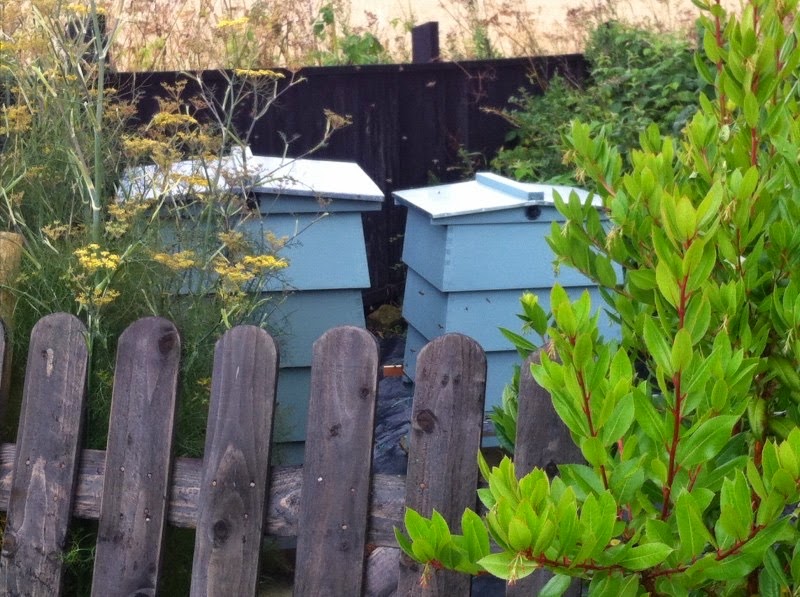
But that’s one evening;  we’ve been, painting new lifts and a nucleus hive the fetching shade of house greeny blue to match the hives in the apiary.   We’ve acquired some bottom bee space supers and they have to be routed to make them top bee space to be compatible with our 14x12 brood boxes.   Everything has to be super clean and that means, scraped, scrubbed with washing soda and lightly scorched with a blow lamp to ensure there can be no residual disease on anything.
I didn’t imagine there would be quite so much carpentry or so much cleaning involved  in beekeeping.
 
oooOOOooo
 
Finally, we've been planning the military logistical exercise that is required to move the G Bees onto their new 14 x 12 brood chamber and onto a clean floor (a good hygiene practice).   The G Bees' floor then has to be thoroughly cleaned so we can switch the Beebettes (if they survive) onto a clean floor, and finally, as our spare floor isn't a varroa mesh floor, we then need to clean the Beebettes' floor and switch the G Bees on to that, rendering the spare solid floor spare again.
 
Now we're waiting for the weather to warm up enough for the early inspections and equipment switch.

Sunday, 18 January 2015

The Apiary in January

Fetching the fondant
 
We’ve been patiently waiting for the right conditions to treat our colonies for Varroa mites.  The idea is to reduce Varroa Mites to a minimum now so that when the weather starts to improve and the Queen starts laying eggs the colony has the best chance of outstripping the increase rate of Varroa Mites.  A healthy and strong colony at the start of the season will give them the best chance of combatting other diseases that can be spread by the Varroa.

We don’t like the idea of using chemicals but the recommended treatment is oxalic acid.  We bought a handy dispensing container of ready mixed oxalic acid which came complete with a demonstration from Bob at the bee shop on how to use it.  He showed me how to use a finger to mark the seam (the gap between two frames) that you’re treating and then move the finger to the next seam before squeezing the dispenser to measure out the next dose.  He zipped the dispenser along the imaginary seam to indicate the speed of application.

Oxalic acid is supposed to be applied after a suitable cold period so that the queen has stopped laying and the amount of brood is as low as possible.  It’s not good for brood.  However, the day for application should be cold enough for the bees to be in a huddle in their nest but not wet or windy to minimise exposing the bees to cold and damp.

After a long cold, wet spell, finally we had the right conditions with a glorious sunny day,  the air temperature at +4C and no wind, or if any, wind from the South.

In the middle of the afternoon, we decided to go ahead with Operation Oxalic Acid.    As instructed by Bob, we were both there for this two man operation; one lifting the lid, top lift and crown board and the other dispensing the chemical to minimise the time the hive was open.

We loosened the straps securing the hives against high winds and “went in”.   In Queen Bee’s hive there was absolutely no sign of life.  We hope the bees were huddled in their nest but it was ominously quiet.  We were in and out as quickly as possible, the sun was shining, we moved on to the G Bees.

Anyone who has read all of these blogs will already be expecting a different situation in Queen G’s hive and you will not be disappointed.  True to form, when the crown board was lifted we could see lots of bees moving about on the top of the frames.  They were close together and fairly central but definitely looking very lively.   Our instructions were that if the bees were crawling around on the frames that implied a high enough temperature for brood so we shouldn’t use the chemical.  We immediately closed the hive.  The top of the hive is where it should be warmest but if the bees are there, they may not be accessing stores lower down or at the sides.  Therefore we rushed back in to the house and put a block of fondant over the hole in the crown board.

We calculated, as best we could, that with the honey we left and the feeding we did in the Autumn, both colonies should have enough stores to get through the Winter but we bought fondant as an emergency top up.  We are assured that the bees will use it if they need to and if they haven’t finished the fondant when they start going out foraging in preference, any that remains can be kept in a sealed container for next year.  So, the G Bees have fondant immediately above their nest and don’t have to go out to the cold edges of the hive for stores.

As new beekeepers, we don't know which of the two situations we found was more normal for the time of year.  I'm keeping my fingers crossed for the Beebettes but I am worried for them. 


Thursday, 1 January 2015

Happy New Year 2015


What do bees do at Christmas?

Do bees sleep?

What do beekeepers get for Christmas?

Want a heads up on our plans for the coming year?

Read on….

Mahonia flowering in the apiary on a frosty morning
 

Lots of friends have asked us whether bees hibernate.  We didn’t know either but we were fascinated to learn that they don’t.   As temperatures drop bees huddle together in a roundish nest.  The colder it gets, apparently the smaller the huddle.  The bees fan their wings and expand the nest to disperse heat and they generate heat by uncoupling their wings and contracting and relaxing their flight muscles to regulate temperature at the centre, keeping it at a remarkably constant 32 C.   So at Christmas this year, the bees were in their nest, creating metabolic heat to keep their Queen snug in the middle.

We didn’t even sneak a look because we don’t want to expose our lovely bees unnecessarily to the cold.

Our interrogators normally swiftly follow the hibernation question by asking whether bees sleep.  Again, we didn’t know but it transpires that bees can’t close their eyes but they do have a kind of resting state which some observant beekeeper's can spot.  Not us though – not yet!

Our top bee related Christmas present this year was a much needed 14x12 brood box for the G Bees to move into in the Spring.  It’s made to measure by Thornes with top bee space and we collect it on 6th January.
A rain gauge  is a welcome addition to the garden weather station.  We can report that we had 15mm of rain/sleet on 27th/28th December.  A super deluxe wasp trap will come in handy but the greatest excitement was generated by a bright yellow stethoscope.  We’re looking forward to using it for non-invasive hive inspections.  So far it’s been too cold and wet to attempt to use it.  We have heard that hungry bees are louder than happy bees – but how will we recognise the difference? And can we make a recording for the blog?
We were also given a bee hotel for solitary bees and two hedgehog houses. I bet nobody else got two of them but I’m not complaining.
Bee hives in December
I’ve got a present for the bees but haven’t given it to them yet.  It’s a packet of fondant per hive.  I’m sure we gave the bees enough feed on top of their honey stores to get them through the Winter but the fondant is the insurance policy.  We cut a flap in the plastic cover and place it over a hole in the crown board and the bees should find it.   We’ve also placed an order for pollen patties via the local beekeepers’ association as it seems bees need pollen as well as honey stores to survive and thrive.

 As for our other plans for 2015, assuming we get both colonies safely through the Winter….
Ø  Move the G Bees in to a 14 x 12 brood box
Ø  Breed new queens from Queen G.   We don’t know how old she is but she has some great qualities – her offspring are good tempered, she lays prolifically, her colony produced lots of honey and they are noticeably diligent about cleaning out their hive which is deemed good for resisting Varroa infestations. 
Ø  Set up a third colony – must make a shopping list of extra equipment required first and this assumes we can make some extra Queens.
I'm studying the Jack Berry method from his book “Queen Rearing with Simplicity” which Sally has loaned to me.  I can see that lots of detailed planning and logistics will be required.

The first real bee related activity of 2015 will be the AGM of the local beekeepers ‘ association and annual dinner.  We're making extra efforts to be able to attend this time because last year we were thwarted in our attempts to get there by widespread flooding and massive traffic congestion.

Best wishes to our reader (you know who you are) for a “hap bee” new year!
 
P and L


Monday, 20 October 2014

Battened Down

Not a real blog, but I couldn't resist posting this photograph of the hives tied down ready for the tail end of hurricane Gonzalo.

Monday, 13 October 2014

Accolades

 
We've reached the end of our first season as beekeepers with the help and support of lots of people so this last blog of the season is dedicated to thanking them for their advice, guidance, support and interest.  In no particular order.....:

Paul and Charlotte for hosting the beekeeping taster session last year.

Paul, Malcolm and Penny for the fantastic theory classes.

Sally for letting us handle her bees at the practical classes.


Douglas for setting up Queen B and the Beebettes.

Richard for his guidance and Jonathan and Ben for their support at the Bee Rescue.

Mr G for breeding Queen G and the lovely G Bees.

Jennie our bee buddy for helping inspect and look after our bees.

BJ, Dad and P, the official photographers.

Eth, for helping everyone.

Joe for dealing with the wasps.

Dee for providing the honey jars and extractor.

Bob at the Thornes for his endless patience.

Dad for our bee suits, for helping transport bees, lift hives, inspect bees, feed bees, for general advice and for making the gate and brood box.

P for the birthday present hive, patience and support (but he had tons of fun with the router, pressure washer, extractor and uncapping knife).

And last but not least all our friends and acquaintances who prompted us to keep these notes.

No blogs now for a while unless I am inspired by the National Honey Show at the end of October.


Monday, 6 October 2014

Bees and Mice

Time to make the bee hives mouse proof


We've had the first frost so it's time to put the mouse guards on the hives.  We know there are mice living in or near the apiary;   just before we brought the Beebettes back to the garden we found this one sunbathing on the floor of the apiary. 


Apparently, they find beehives attractive, warm, cosy homes for the Winter.  Bees don't mind them but the mice make a mess of the frames when they remodel to build their own nests.    As they can squeeze through tiny gaps and holes, metal mouse guards are placed over the hive entrance which have holes in that are big enough for bees to enter and leave the hive but which keep mice out.
 

The down side is that the mouse guards may knock the pollen off that the bees are still bringing back in to the hive and they make it more difficult for the house keeping bees to remove debris but with mice in the apiary we don't want to take any chances.
 
We are still keeping the entrances narrow to make it easier for the bees to defend their hives from the wasps lurking about.


Tuesday, 30 September 2014

Varroa Part Two

The results are in

The weather continues to be unusually dry and warm both during the day and at night.   Our two hives are as busy as ever and we have now finished feeding the two colonies for the time being.
 
The bases of the hives are made of mesh which provides good ventilation but also allows dead Varroa mites and other debris to fall through.   To check the Varroa count, we slide trays under the mesh floors to catch the debris. 
 
When we did this before giving the bees a Varroa treatment, we found a few dead Varroa mites on the Beebettes' hive but none on the G Bees' hive and we wondered why because, this year, according to the BBKA, high Varroa counts have been seen throughout the country.
 
When we put the trays back under the hives for the post treatment count, I was extra careful to create a thick Vaseline border around the edge which is supposed to trap any creatures that have a mind to crawl on to the trays to eat the debris.  I can report that this was spectacularly unsuccessful.   As I withdrew the trays from under each of the hives, earwigs scampered over the Vaseline to escape.  The one earwig that looked trapped in the Vaseline subsequently jumped off and is now living in the kitchen somewhere.
Beebettes

G Bees
 
So, you won't be surprised to learn that we didn't see any Varroa this time on either hive.   On the face of it, the results are what we should expect, that is there are fewer Varroa mites in the hives now than before we gave the bees the Varroa treatment.  However, we have to ask ourselves:
a) Were the things we thought were Varroa mites really Varroa mites?  If we get out a magnifying glass will we see hundreds of smaller mites?   Well, I did this and the answer appears to be no.
b) Is the mesh on the G Bees' hive too small for the mites to drop through?  I haven't been able to check yet as the floor is firmly glued in place with propolis.  
 
Another explanation could be that the Beebettes' brood chamber sits on the hive floor but the G Bees' brood chamber is sitting on top of a super of stores (this being a much bigger colony and needing more food for the Winter) so any debris has further to fall and may have got stuck in the super en route.